
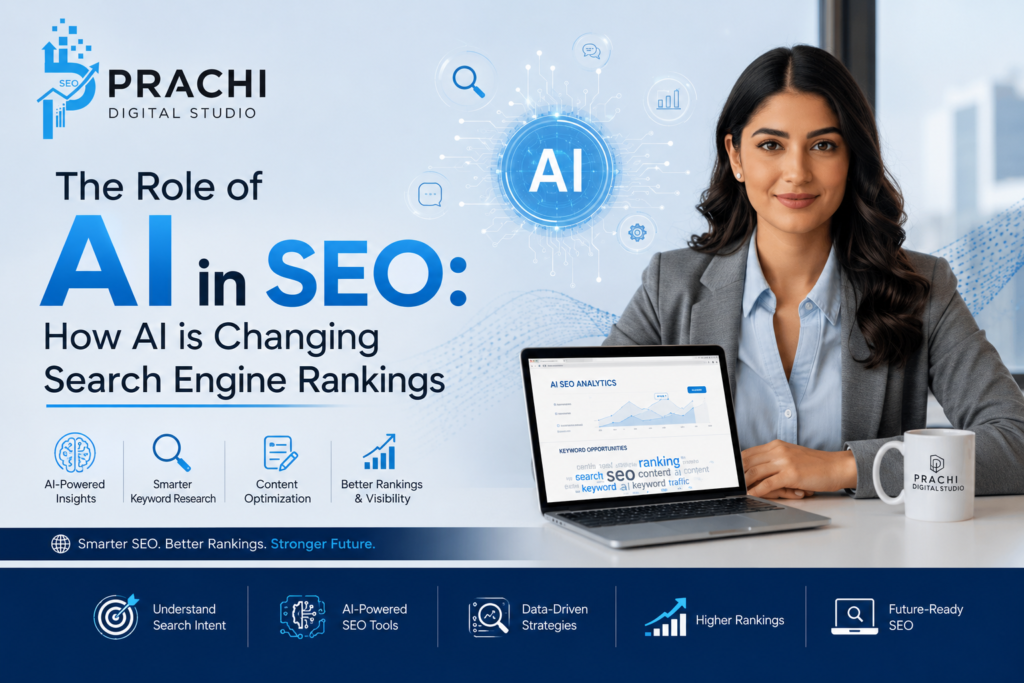
Introduction
The digital marketing world is evolving rapidly, and AI in SEO has become one of the most important trends shaping online visibility. Artificial Intelligence is transforming how search engines understand content, rank websites, and deliver results to users. Businesses that adapt to these changes can improve their rankings, attract more traffic, and stay ahead of competitors.
Today, search engines like Google use advanced AI systems to analyze user behavior, understand search intent, and provide highly relevant results. This means traditional keyword stuffing and outdated SEO strategies are no longer effective. Instead, marketers must focus on high-quality content, user experience, and smart optimization techniques.
In this blog, we will explore how AI in SEO is changing search engine rankings, the benefits of using AI-powered strategies, and the growing importance of modern optimization techniques in the future of digital marketing.
Understanding AI in SEO
What is AI in SEO?
AI in SEO refers to the use of Artificial Intelligence technologies to improve search engine optimization strategies. AI helps analyze massive amounts of data, identify patterns, predict trends, and automate SEO tasks that would normally take hours of manual work.
Search engines now rely heavily on AI algorithms to understand:
- User intent
- Content relevance
- Website quality
- Search patterns
- User experience signals
As AI becomes smarter, websites need more strategic optimization methods to achieve better rankings.
How Search Engines Use AI
Google and other search engines use AI-driven systems such as RankBrain and machine learning algorithms to improve search results. These systems evaluate user behavior and determine which pages best satisfy a search query.
Some key ways AI affects rankings include:
1. Understanding Search Intent
Modern search engines focus on what users actually mean rather than exact keywords. AI helps Google interpret natural language and conversational searches more accurately.
2. Content Quality Analysis
AI evaluates content based on readability, relevance, originality, and user engagement. Thin or low-quality content is less likely to rank well.
3. Voice Search Optimization
Voice assistants like Google Assistant and Alexa rely on AI to process spoken queries. This has increased the importance of conversational content and long-tail keywords.
4. Personalized Search Results
AI customizes search results based on user location, interests, browsing history, and preferences.
Benefits of AI in SEO
Faster Data Analysis
One major advantage of AI in SEO is the ability to process large datasets quickly. AI can identify ranking opportunities, analyze competitors, and detect website issues within minutes.
This helps marketers make smarter decisions faster.
Improved Keyword Research
AI-powered tools can discover high-performing keywords, analyze search trends, and predict future keyword opportunities. This allows businesses to target the right audience more effectively.
Many modern AI SEO tools can even suggest semantic keywords and related search phrases to improve content relevance.
Better Content Optimization
AI helps optimize content by analyzing:
- Keyword placement
- Readability
- Search intent
- Topic relevance
- User engagement metrics
With proper optimization, businesses can create content that performs better in search rankings.
Enhanced User Experience
Google prioritizes websites that provide a smooth user experience. AI helps improve website performance through:
- Faster loading times
- Better mobile optimization
- Personalized content recommendations
- Improved navigation
A positive user experience directly impacts search rankings.
The Impact of AI on Search Engine Rankings
AI is Redefining Ranking Factors
Traditional SEO focused mainly on backlinks and exact-match keywords. However, AI in SEO has shifted the focus toward user satisfaction and content quality.
Search engines now evaluate:
- Time spent on page
- Bounce rate
- Content usefulness
- Mobile responsiveness
- Page experience
Websites that prioritize user needs are more likely to rank higher.
Rise of Semantic Search
Semantic search allows search engines to understand the context behind queries instead of matching exact words.
For example, Google can now understand that “best smartphone for photography” and “top camera phone” have similar intent.
This means content creators must focus on topic relevance rather than simply repeating keywords.
Automation in SEO Strategies
Many businesses now use AI SEO tools to automate repetitive tasks such as:
- Site audits
- Content analysis
- Keyword tracking
- Competitor research
- Link monitoring
Automation saves time while improving efficiency and accuracy.
Popular AI SEO Tools Used Today
Several advanced AI SEO tools are helping marketers improve rankings and productivity.
1. Surfer SEO
Surfer SEO analyzes top-ranking pages and provides content optimization recommendations based on real-time search data.
2. SEMrush
SEMrush offers AI-powered keyword research, competitor analysis, and SEO auditing features.
3. Jasper AI
Jasper AI assists in content creation by generating SEO-friendly blog posts, headlines, and descriptions.
4. Clearscope
Clearscope helps improve content relevance by suggesting important keywords and topics.
5. ChatGPT
AI writing assistants like ChatGPT support content ideation, optimization, and research, making SEO workflows faster and more efficient.
Challenges of AI in SEO
Overdependence on Automation
While AI tools are helpful, relying completely on automation can lead to generic content. Human creativity and strategic thinking are still essential for successful SEO.
Constant Algorithm Updates
Search engine algorithms continue evolving rapidly. Businesses must stay updated with AI-driven ranking changes to maintain visibility.
Content Authenticity
AI-generated content must still provide real value. Search engines prioritize helpful, trustworthy, and original content over mass-produced articles.
Future of SEO with Artificial Intelligence
The Future of SEO is AI-Driven
The future of seo will be heavily influenced by Artificial Intelligence and machine learning technologies.
Key future trends include:
1. Predictive SEO
AI will predict search trends before they become popular, helping businesses create content earlier than competitors.
2. Hyper-Personalization
Search results will become even more personalized based on user behavior and preferences.
3. Smarter Voice Search
Voice search optimization will become increasingly important as more users rely on smart assistants.
4. Visual Search Growth
AI-powered image recognition technology will improve visual search capabilities, allowing users to search using photos instead of text.
5. Advanced User Experience Signals
Search engines will place even greater importance on website experience, engagement, and accessibility.
The future of seo will require businesses to focus more on quality, relevance, and user intent rather than outdated optimization tactics.
Best Practices for Using AI in SEO
To succeed with AI in SEO, businesses should follow these best practices:
Focus on High-Quality Content
Create informative, engaging, and original content that solves user problems.
Use AI Tools Strategically
Leverage AI SEO tools for research and optimization while maintaining human creativity in content creation.
Optimize for User Intent
Understand what users are searching for and create content that directly answers their questions.
Improve Website Performance
Ensure your website is fast, mobile-friendly, and easy to navigate.
Stay Updated with SEO Trends
AI and search algorithms evolve constantly, so continuous learning is essential.
Conclusion
The rise of AI in SEO is transforming the digital marketing industry in powerful ways. Search engines are becoming smarter, more user-focused, and increasingly dependent on Artificial Intelligence to determine rankings.
Businesses that embrace AI-driven strategies can improve efficiency, enhance content quality, and achieve stronger online visibility. From keyword research to content optimization and predictive analytics, AI offers endless opportunities for modern SEO success.
At the same time, the human element remains important. Creativity, authenticity, and user-focused content will always play a major role in long-term rankings.
As the future of seo continues evolving, businesses that combine human expertise with advanced AI technologies will gain the greatest competitive advantage.
FAQs
1. What is AI in SEO?
AI in SEO refers to the use of Artificial Intelligence technologies to improve search engine optimization strategies, analyze data, and enhance website rankings.
2. How does AI affect search engine rankings?
AI helps search engines understand user intent, analyze content quality, and deliver more relevant search results, which directly impacts rankings.
3. What are AI SEO tools?
AI SEO tools are software platforms that use Artificial Intelligence to automate SEO tasks like keyword research, content optimization, and site analysis.
4. Is AI replacing traditional SEO?
AI is not replacing SEO but improving it. Human creativity and strategic thinking are still essential for effective optimization.
5. What is the future of SEO?
The future of seo will focus more on AI-driven personalization, voice search, predictive analytics, and user experience optimization.